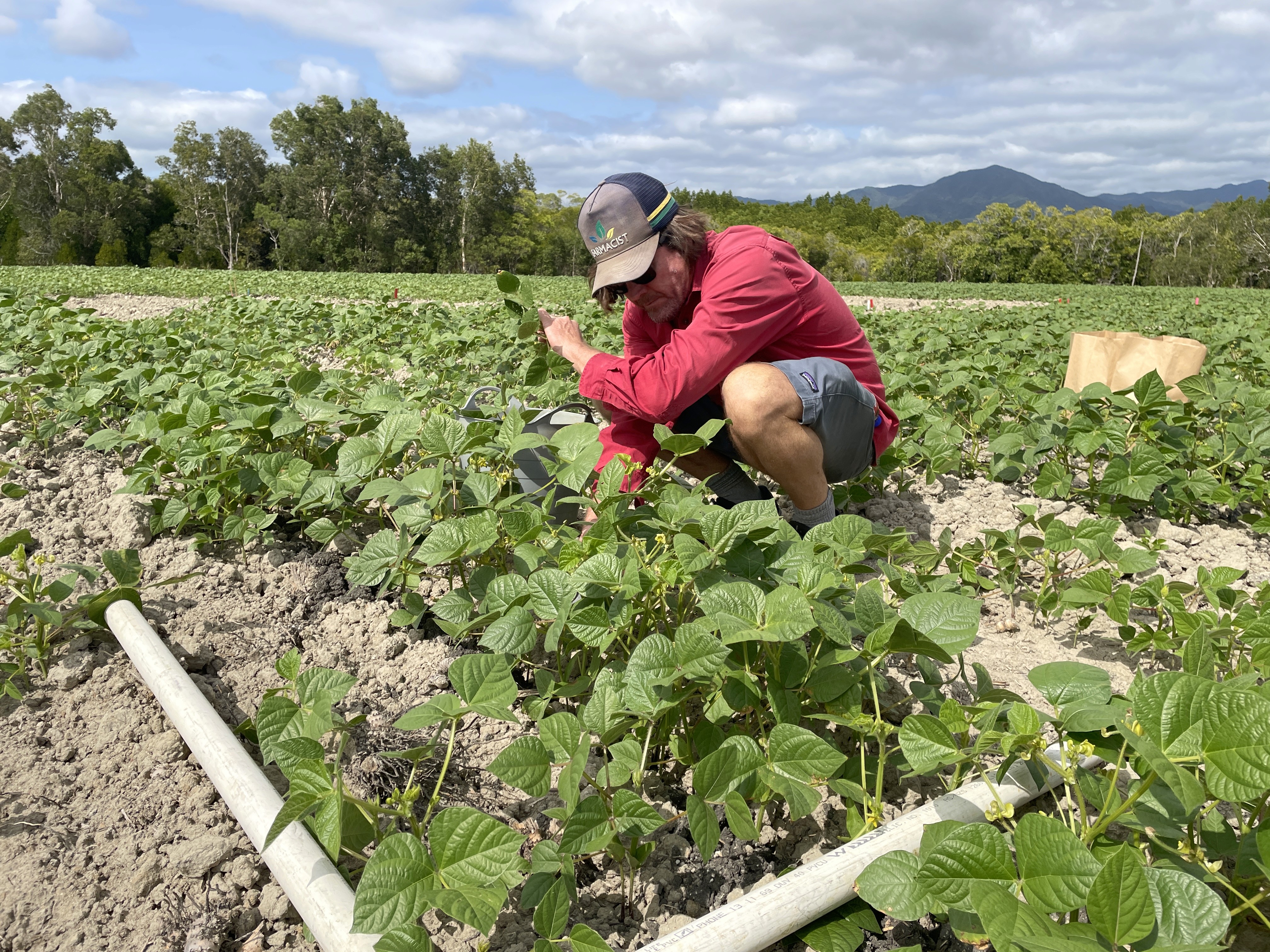
Farmacist has been working with Far North Queensland Essential Oil (FNQEO) to show tea tree growers in Dimbulah, Mareeba and Atherton the benefits of soil moisture monitoring. FNQEO received funding through the AgriFutures Producer Technology Uptake Grants program and engaged Farmacist to install Green Brain soil moisture monitoring equipment and rain gauges on four properties and coordinate grower extension.
The kit
An 80 cm EnviroPro soil moisture and temperature probe with sensors every 10 cm
A Green Brain tipping bucket rain gauge
A Green Brain data logger with battery, solar and cellular capability
At the Atherton installation, the probe is buried 10 cm below the surface between trees. Readings from each sensor are stacked in a graph, so growers can see moisture from the top of the profile to the bottom alongside rainfall.
Four sites, four situations
Dimbulah: a three-year-old crop on Dimbulah sand with solid-set irrigation, using long weekly irrigations.
Dimbulah: a crop under 12 months old on Dimbulah sand with solid-set irrigation, using shorter twice-weekly irrigations.
Mareeba: a five-year-old crop on a Cobra soil (sandy loam to clay loam) using responsive irrigation that changes with the time of year and crop size.
Atherton: a five-year-old crop on a Tolga soil (non-cracking clay loam) with subsurface drip irrigation.
Using the data
Growers can log on to the Green Brain platform to view data from all four sites, and all growers in the FNQEO cooperative have access. Farmacist has helped each grower get comfortable with the platform and planned workshops on irrigation practice and efficiency. As the data set grows, the group will compare approaches to irrigation and what they mean for productivity and costs.
The main challenge was reliable connectivity at the first Dimbulah site, solved by putting the data logger on a very tall mast.
This article was first published in Farmacist News, July/August 2022, written by Belinda Billing.
Questions about this topic?
Talk to your local Farmacist agronomist about how this applies to your farm.
Contact us