Reducing Nitrogen Without Losing Yield: PastureN Microbial Fertiliser in Sugarcane
Reducing Nitrogen Without Losing Yield: PastureN Microbial Fertiliser in Sugarcane
Cutting nitrogen rates is attractive on cost and on water quality — but only if yield holds. On-farm demonstrations in the Mulgrave area tested PastureN, a microbial enhancement fertiliser, to see if it could support reduced nitrogen inputs without sacrificing productivity.
What is PastureN?
PastureN is applied as a liquid containing nitrogen-fixing and Bacillus microbes together with plant-based amino acids. The nitrogen-fixing microbes colonise the plant, root surface and surrounding soil, fixing atmospheric nitrogen into plant-available ammonium nitrogen. The Bacillus microbes promote a balanced soil microbiome and may inhibit pathogenic fungi and bacteria, while the amino acids enhance uptake and can stimulate crop growth.
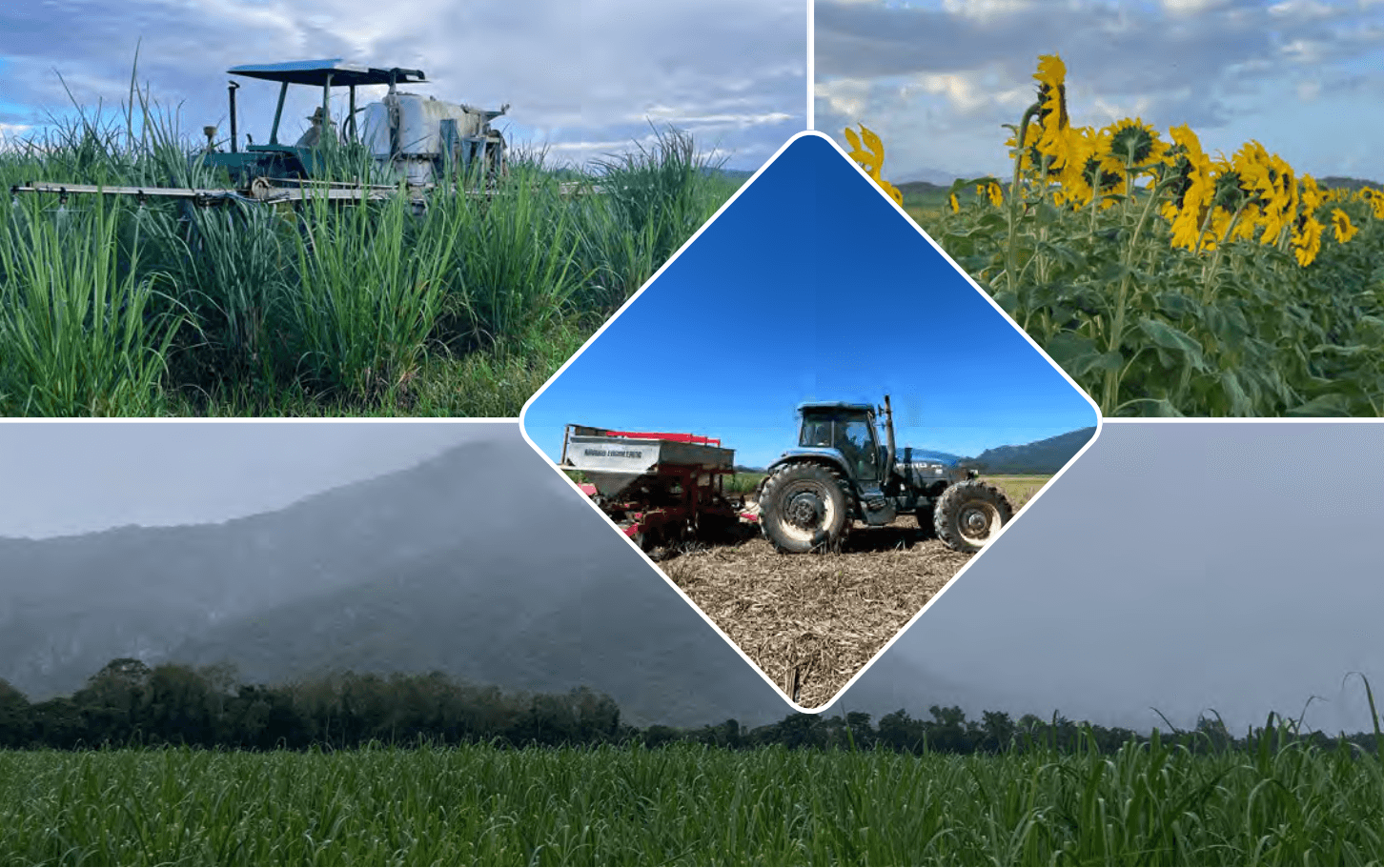
Application requirements are specific. PastureN should be applied in at least 100 L of water per hectare in moist conditions on actively growing cane with enough leaf area for colonisation — typically early in the wet season using a high-rise sprayer. Hot, dry or windy conditions can damage the microbes. The freeze-dried nitrogen-fixing microbes must be rehydrated and mixed with the Bacillus microbes and amino acids in a clean tank (about 30 minutes), and the product requires refrigeration before use. Each pack covers 5 ha at about $40/ha.
Trial 1 — Aloomba (SRA 26, 1st ratoon, Innisfail soil)
Four treatments crossed two fertiliser rates with and without PastureN, at five replicates each:
Treatment | Cane yield (t/ha) | CCS | Sugar yield (t/ha) |
|---|---|---|---|
120 kg N/ha | 117.44 | 11.40 | 13.41 |
120 kg N/ha + PastureN | 118.53 | 11.53 | 13.66 |
90 kg N/ha | 118.07 | 11.82 | 13.95 |
90 kg N/ha + PastureN | 118.78 | 11.97 | 14.22 |
There was no significant difference between treatments. The practical reading: fertiliser could be reduced by 25% with no yield impact at this site that season, with no evidence that PastureN itself lifted yield. PastureN did, however, reduce variability in CCS results. (The 120 kg N/ha rate already reflects the grower's reduced practice against a full SIX EASY STEPS rate of 140 kg N/ha for the soil type.)
Trial 2 — Little Mulgrave (Q200, 5th ratoon, Clifton soil)
The grower's already-reduced standard rate was compared with and without PastureN (three replicates each):
Treatment | Cane yield (t/ha) |
|---|---|
Grower rate + PastureN | 50.36 |
Grower rate only | 43.71 |
PastureN was associated with higher cane yield (a difference of around 6.6 t/ha) and much less variability across replicates. A mill issue lost the CCS data, so sugar per hectare could not be calculated. The recommendation across both trials is consistent: PastureN shows enough promise — particularly for reducing variability — to warrant continued investigation across multiple years, soils and climates, but it is not yet a proven yield booster.
Trial 3 — Mirriwinni (Timara Coom soil, SRA 6, 3rd ratoon)
This trial compared two nitrogen rates with and without PastureN (four replicates each). The main nitrogen rate trial results (without PastureN) were:
Treatment | Cane yield (t/ha) | CCS | Sugar yield (t/ha) |
|---|---|---|---|
50 kgN/ha | 92.34 | 11.58 | 10.69 |
100 kgN/ha | 95.87 | 11.96 | 11.47 |
150 kgN/ha | 104.18 | 11.93 | 12.41 |
200 kgN/ha | 109.12 | 12.16 | 13.27 |
PastureN results: There was no significant difference between treatments with or without PastureN. Higher nitrogen rates (150 and 200 kg/ha) performed significantly better on this soil type.
Key takeaways
PastureN results were mixed across the three trials.
It allowed a 25% nitrogen reduction at Aloomba with no yield loss and lower CCS variability.
It increased cane yield by ~6.6 t/ha at Little Mulgrave.
No significant yield benefit was seen at Mirriwinni, where higher nitrogen rates drove the best performance.
PastureN shows the most promise for improving consistency (reducing variability) and supporting lower nitrogen rates on some soil types.
Frequently Asked Questions
Does PastureN increase sugarcane yield?
Results are mixed. No significant increase at Aloomba or Mirriwinni, but ~6.6 t/ha higher cane yield at Little Mulgrave. It often reduced variability in yield and CCS. Further multi-year trials are recommended.
How is PastureN applied to sugarcane?
As a liquid in at least 100 L of water per hectare on actively growing cane in moist conditions, ideally early in the wet season with a high-rise sprayer. Avoid hot, dry or windy weather. Specific mixing and refrigeration are required.
What are the main benefits observed?
Potential to maintain yield with lower nitrogen rates on some sites and improved consistency (lower variability) in cane yield and CCS.